|
|











Steve Yett went on to graduate from USC with his Bachelor of Architecture degree. He worked for a number of corporate firms the years following graduation, but grew tired of their politics, and more importantly felt like they weren't really doing architecture. |
Eventually, Steve went to work for Malibu architect, Mike Barsocchini. |
"Mike's one of the coolest architects that I've ever met. He did his internship under Lloyd Wright. He used to race cars with Steve McQueen. There's quite an Impressive list of alumni that have |
worked for Mike… Some very famous architects…. Mike should be famous in his own right - he's completed some pretty impressive structures. But he doesn't really care about glory. It seems like he genuinely just likes doing the projects with minimal accolades. The best reward is the work itself. " |
Steve Yett received his Architecture License in 1995. Appropriately enough, the first job that he completed under his license was a surf shop that he did for the fee of a new board. Since then, he has completed a 99 seat equity-waiver theatre, a deli/market, a toy store, a drug store, a dress shop, several offices and even the old City of Malibu Building Department public counter. Currently he is involved with the Point Dume Village shopping center remodel. But the mainstay of his practice has always been residential work - both remodels and new construction. |
"The shift to architecture made the most sense to me." Steve Yett says definitely tongue-in-cheek. "Matt Kivlin, the inventor of the short surfboard, went on to become an architect. And look at John Lautner - most of his projects look like waves." |
Steve Yett realized that he wanted to be an architect after a near-death skateboard accident in the 6th grade. Bedridden for the five months following the event that left him with a double skull-fracture, he had plenty of time to reflect on his earlier chosen career path a surfer/skateboarder. |
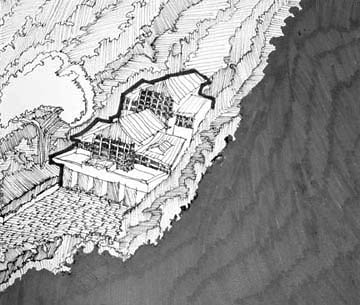
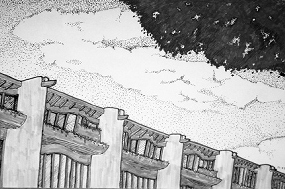
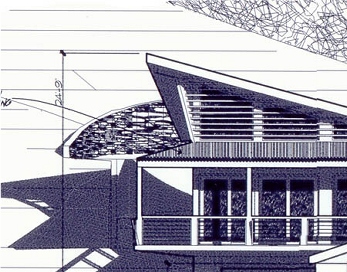
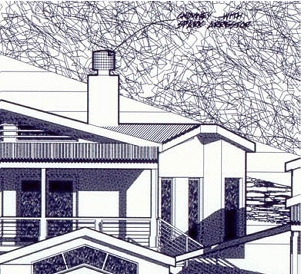
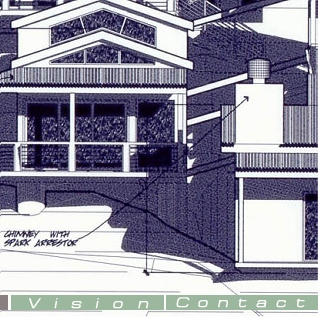
Steve Yett is in the somewhat unique position that he is both a part of the last generation of architects to learn how design by hand drawing, as well as the first pioneers of the CADD age. As a result, his computer drawings are meticulous - and many people don't believe that they have been done on the computer. |
"I refuse to let my drawings look like a robot drew them. I first started out on Autocad which I found to have severe limitations. I have been using Archicad exclusively for almost ten years now. It's a ridiculously fast stand-alone program that makes movies, renderings, plans, elevations, sections - all from the same file. It actually has changed my whole approach to design." |
His general approach to architecture is to try to be as flexible as possible while keeping his eye on the endgame result that the project has to be built. He views design as a collaboration between himself, the owner, the site, the governing codes, the other required engineering and design disciplines, as well as the contractor. |
"When I was still in school I went to a lecture by San Diego architect Rob Wellington Quigley. His general attitude was not to let anything phase him…. I remember there was some project where they found an Indian burial site and he showed how he sculpturally ran the building around the location. And almost every project he started off telling the audience a quirky request that the client made, where they would ask him '….Is that alright?…" And he had this attitude of not only the request being alright, but it became a major component of what made the project interesting." |
"I had this one client, a couple, for the sake of speed of design, the husband left me and the wife alone to design the house. She owns a parrot, so her and I designed this unique shaped courtyard for the parrot in the center of the house. Parrots can't helicopter, so no clear distance of the courtyard could be greater than 15 feet. Anymore than that and the parrot could fly out. Of course when the husband saw the plans, he laughed that we hadn't accounted for hawks swooping in and attacking the parrot…. At any rate, the parrot's courtyard is the central element of the house." |
When you look at the full scope of Steve Yett's work, you immediately notice that it's all drastically different, both in scale and style. |
"That's because the clients and their individual needs are all completely different.." |